
Screeninfo Editor
Why We Should Recommend an LCD Video Wall to Our Customer’s Busines

Video walls represent one of the fastest-growing areas of the Digital Signage industry, and it’s only a matter of time before you start expressing an interest in these high-impact displays. But considering all the video wall technology available today, what type of display is best for you?
Far and away, the LCD video wall is the right choice for most customers. Of course, there will be the occasional end user who still requests a rear projection screen or needs LED arrays or DLP tiles for a highly customized display. But today’s LCDs offer the best resolution for the price, plus a whole host of other features, making them ideal for most video walls.
Consider these top reasons you should recommend an LCD video wall for your customer’s business:
1. Better aesthetics.
LCD video walls are hard to beat when it comes to a seamless, modern-looking appearance and crystal-clear display. That’s because HD LCDs offer industry-leading resolution, and displays that are designed for video walls have thinner bezels—the frames around each screen—than ever before. The result is a high-impact display that looks like one cohesive unit, rather than multiple disparate screens tied together.
2. More dynamic content.
LCD video walls can offer a broader range of content options, simply because the displays are so versatile. Video, still images, audio, text and more can be piped in from a network computer, streamed from YouTube, sourced from content providers and brought in from a variety of other sources. This helps to keep the content dynamic and relevant to the consumer.
3. Advanced features.
These days, video walls are all about interactivity. After all, it’s one of the best ways to engage consumers with a particular brand or product. So when you’re considering advanced features, keep interactive capabilities in mind.
Be sure that your customer is aware of some of the incredible advanced features that are available today:
-
Touchscreen interfaces: Enable users to scroll through product and wayfinding information, play games and engage with “infotainment” content
-
Gesture-recognition technology: Using Microsoft Kinect-like software, users can control various graphical elements on a video wall through gestures and body movements
-
Social media integration: Encourages users to share their thoughts, reviews and experiences through the video wall, providing an enhanced level of engagement to both the sharers and the viewers
4. Price.
Of course, the bottom line is one of the most compelling reasons to go with LCD. These screens have fallen significantly in price over the last several years, making them even more ideal for the multi-screen nature of a video wall. (After all, who wants to spend tens of thousands of dollars on the screens alone?)
As the price of LCDs continues to fall, video walls become a more viable option for a larger percentage of businesses.
Call Screeninfo and got more information +45 20 219 322
Nyhed, Ultra Lang Interactive Touch Skærm
Denne nyhed fra vores samarbejdspartner, kan passe til en masse spændende formål i detail, restaurationer, barer, spillesteder, rejsebureauer etc. etc Ring til os og få flere idéer
Design med det digitale lærred
Med den rigtige software og den rette touch teknologi kan f.eks designer og grafikere opnå gode resultater til præsentationer events el. lign. Kontakt os og hør nærmere om trenden i Digital Signage

Video in Digital Signage attracts all audiences

Moving pictures have captivated audiences for more than a century. Animation and video bring a special level of entertainment that appeases all audience personas. Why? Watching a video requires minimal effort, and the information is easily absorbed and retained.
Video communications are a whopping 600-percent more effective than print and direct mail.¹ Viewers are accustomed to watching video through multiple mediums a day: TVs, computers, smartphones, mobile devices, etc. In fact, 60 percent of media viewers will watch a video before reading any text.¹
According to ReelSEO’s article, “2013 Video Marketing Survey & Business Video Trends Report,” 93 percent of marketers are using video in their campaigns, while 82 percent of them claim video has a positive impact on their business.¹ Luckily, advancements in technology have made it easy to bring this magical tool to your digital screens.
Video Relevance
The luxury of video on digital signage is similar to hosting your own television channel; the content options are endless. If you’re playing video to attract attention to your screens, make sure your content is relevant and appropriate. A veterinarian’s office isn’t likely to play celebrity gossip clips in the waiting room; instead they might opt for a video about proper ways to groom your pet.
The types of video used on digital signage should depend on sign location, audience and communication purposes. The lobby of a large business might opt to play a “welcome” video, while dentist offices or hair salons may play news clips. Internal, employee-facing signage minimizes training time by playing safety videos or training presentations, while trendy retail stores might play customer-created content or video promoting their upcoming specials.
Video Length
Shorter videos have a positive impact on viewers. Videos under one minute tend to have an 80-percent viewer retention up to the 30-second mark, while videos running at two-three minutes drop to a 60-percent retention rate.¹ So, stick to shorter videos to engage and create a positive impact on your viewers.
If you are creating the video in-house, be sure to display the most important information first — especially in high-traffic areas where viewers might only be able to catch the first clip of the video. Think of the beginning moments of the video as the prime time to communicate your message.
Video is one of the most effective ways to communicate complex information in a short time frame to all audiences. The motion graphics attract viewer attention, while the video content creates extended engagement.
(¹Source: ReelSEO.)
DISE Citibank 4K Video Wall, Hong Kong
See how digital signage software solutions for large scale, data driven, video walls has been used for this very impressive 4K LED wall at Citibank’s Wheelock House branch, Central District, Hong Kong.
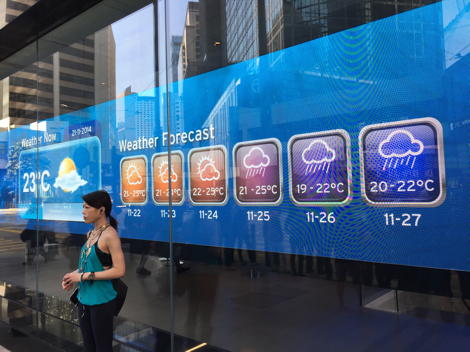
We’ve made mention before that DISE (said software solution) is probably more well known, and much more widely used, in Asia than in Europe (at present, at least).
Two 1.9 mm LED screens are installed back to back, one displaying inside the branch (shown below) whilst the other faces the street (shown above), therefore serving both customers and staff inside the branch and the general public who pass by the bank.
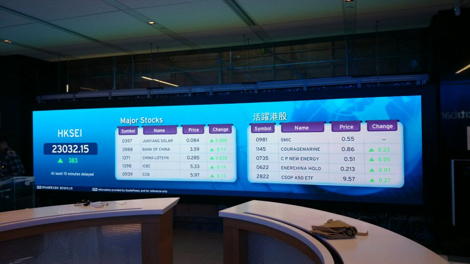
The installation includes redundant display system architecture, real time information integration with stock prices, weather and breaking news, coupled with advance scheduling for displaying other content at specific time intervals.
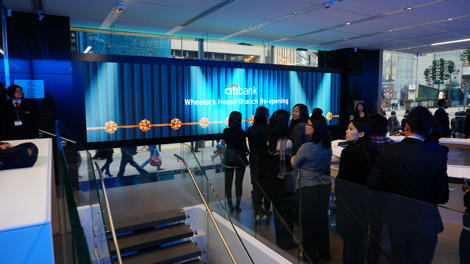
The LED screens were also used as a digital backdrop during the branch’s re-opening ceremony.
Julemanden bruger Digital Signage og skaber fantastisk oplevelse !!!

Microsoft and Virgin Atlantic Airways brought some special Christmas cheer to flyers on the airline’s London-to-Boston flight over the last weekend before Christmas.
Using projection digital signage tech, the airline showed the Christmas icon and his reindeer landing on top of the plane before St. Nick came into the plane through its special “Santa hatch,” visiting with passengers and taking Santa selfies with children, families and flight attendants before heading back out to his sled and “jetting back off into the night sky,” according to Virgin founder Richard Branson’s blog.
Before boarding, the passengers were given early Christmas presents from Microsoft — Windows tablets for all. The passengers could use the tablets to track Santa on NORAD’s Santa Tracker, and somewhere near the coast of Greenland, Santa’s sleigh caught up with the flight and he decided to come inside to say hello to the passengers, according to an announcement from Microsoft:
Via a series of projections onto the cabin ceiling, passengers watched the sleigh land on the aircraft before [Santa came] walking down the aisles, delighting children and taking selfies with surprised passengers. The passengers were then able to watch Santa prepare his crew for departure before heading off into the night sky.
“We wanted to offer something extra special for the families flying with us this Christmas, and who better to spread the Christmas cheer than Santa himself?” Virgin Atlantic Head of Customer Experience Debbie Hulme said in the Microsoft announcement. “We decided to partner with Microsoft as it was the only provider that could offer the breadth of cool technology that Virgin Atlantic passengers expect from us … Microsoft is also providing us with the analytics to look at how passengers interacted with the technology so we can work out what they enjoyed the most. This will enable us to continually improve and innovate. Expect to see more from Virgin Atlantic and Microsoft in 2015.”
“Through this experience we are looking to explore how the aircraft can be brought to life in different ways via the use of digital technologies to amplify the amazing service that is offered to customers today and how passengers engage after the flight,” Microsoft Connected Digital Services Creative Director Fred Warren said in the announcement. “We were able to give passengers a glimpse of what is possible from more immersive flight experiences.”
Watch a video from Virgin about Santa’s surprise visit here:
Hvordan bilforhandlere kan drage fordel af Digital Signage
Like any other industry, the auto sector is heavily reliant on consumer engagement for establishing brand awareness. This is an area where digital signage becomes a pivotal resource for creating a satisfying customer experience.
Of course, car dealership signage displays are nothing new. Many people have seen those large overhead signs outside the dealership that displays text information about the latest inventory lineup. However, there is so much more that can be done with signage displays especially when it comes to the auto industry.
The Role of Digital Signage in Car Dealerships
Think about some of the unconventional and interactive ways companies have incorporated digital signage into their PR foray. A lot of these marketing stints include interactive displays, games, and QR codes for downloading free content. Dealerships can adopt a similar approach within their facility to get consumers engaged and asking questions to pique their interest.
Dealership Signage Campaigns to Consider
Displays can be strategically placed throughout the lobby, waiting rooms, and showrooms. They are especially useful for events like car trade shows where a display can be positioned next to the featured car. Think about the type of content that can be displayed. Consider some of the following ideas:
The third point really deserves extra consideration. Consumers will more likely remember promotional content that contains some form of interactive display. Check out this video taken at an Audi expo.
Once all the modifications are made, consumers get a full summary report of the features and the suggested retail price of the car with all the selected customizations. What’s more, customers are also given a code to save the specs into their mobile device where they can share with their friends.
Digital displays can also be utilized in areas like the lobby to keep customers entertained while they wait for the next available dealer. Content in this instance can include current financing options, a synopsis of the latest model release, features that distinguish their brand from other manufactures, or even generic information like the weather or news.
Why Car Dealership Signage Displays Are Beneficial
The target audience in the auto sector is the same as the demographic in most other industries. They want something that will intrigue them, and ads like static signs and posters simply don’t captivate an audience. Digital displays that show the latest car commercial and incorporate interactive features are far more effective at creating curiosity and a desire to learn more. Once consumers are hooked, they will respond in kind, such as by talking directly with a dealer, enquiring about a specific model, visiting the dealer website, or sharing their experiences on social media.
The auto industry has everything to gain by making digital signage a regular part of their in-facility campaign. The demographic is one that compares brands and does a lot of research, so having a digital display rich in interactive content will certainly help influence their decision.
